

The Variant Perception Read
The surface narrative: Trump wants peace. Vance flies to close the deal. Markets price de-escalation.
The actual signal: Trump is sending his family office to negotiate — not the State Department, not the NSC, not career diplomats. Rubio is nowhere near this meeting. That is not an accident.
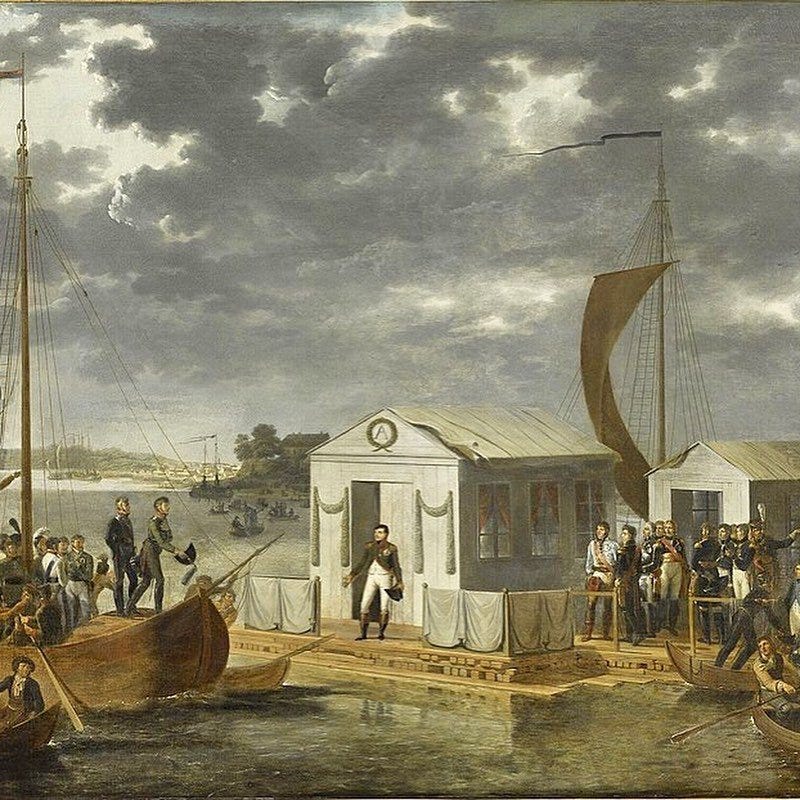
Napoleon at Tilsit, 1807.
He showed up having already won. Alexander thought he was negotiating. Prussia had no seat at the table.
The deal was structured before the meeting started.
Sound familiar?
Layer 1 — This Is a Property Acquisition, Not a Peace Deal
Trump doesn’t think in geopolitical frameworks. He thinks in assets. What does Iran have that Trump wants?
The Strait of Hormuz — the most valuable maritime chokepoint on earth
Iranian oil — currently sanctioned, sitting idle, representing massive latent supply
Regional stability as a product he can sell to Gulf states who will pay for it
Kushner’s entire Middle East playbook in Term 1 was the Abraham Accords — which were explicitly transactional. Normalize relations, unlock economic flows, take a fee in the form of geopolitical credit. The Gaza deal followed the same structure. This is deal number three in the same franchise.
The variant perception: Trump isn’t ending a war. He’s closing a real estate transaction where the asset is Middle East stability and the buyers are Saudi Arabia, UAE, and the Gulf states who will fund the reconstruction. Kushner has the relationships with every Gulf sovereign wealth fund. That’s not coincidence — that’s the monetization layer.
Layer 2 — Vance Is There Because He’s Running in 2028
This is the piece nobody is saying out loud. Vance doesn’t fly to Islamabad to sit in a room for optics. He goes because he wants the photograph and the headline — VP brokers Iran peace deal — on his résumé before the 2028 primary begins.
Trump knows this. Trump uses this. Vance’s personal political incentive to close is the enforcement mechanism that ensures the delegation doesn’t come home empty-handed. You don’t send someone with a legacy motive unless you want maximum closing pressure in the room.
The variant perception: Trump has aligned every principal’s personal incentive with the outcome he wants. Vance needs a win. Kushner needs a legacy. Witkoff needs the next deal. Iran gets to survive. Trump gets the Nobel narrative. This isn’t diplomacy — it’s incentive architecture.
Layer 3 — Iran Already Knows They Lost
Here’s the read the market is completely missing. Iran published a 10-point proposal. Think about what that actually means strategically.
When you publish your terms in a negotiation, you’ve already surrendered the leverage of ambiguity. You’ve told the other side exactly what you need, which means they know exactly what to give you and what to withhold. Professional negotiators never do this. Iran did it because they needed to signal to their own domestic audience that they extracted terms — not because they had leverage.
The Hormuz closure was their nuclear option. They played it. The US didn’t blink — they escalated harder, hit Kharg Island, and sent the VP. Iran’s only remaining play is to get the best possible terms on the way out.
The variant perception: Iran walked into this negotiation having already lost. The 10-point proposal is a surrender document dressed up as a negotiating position. The question isn’t whether a deal gets done — it’s how much face-saving architecture Witkoff builds around the Iranian capitulation.
Layer 4 — The Pakistan Choice Is a Message to China
This is the deepest layer and the one zero people are talking about.
Why Pakistan? Pakistan is militarily and economically closest to China of any US-adjacent mediator. Pakistan’s powerful military has deep PLA relationships. Choosing Pakistan as the venue is a direct signal to Beijing: we are resolving the Middle East on our terms, through your allies, without you.
Trump is showing China he can stabilize the region that China depends on for energy — without Chinese involvement — right before his planned Beijing visit. That’s not a coincidence. That’s positioning.
The variant perception: The Islamabad meeting is partially a message to Xi. Trump is demonstrating that he controls the energy security architecture of the Middle East and can turn it on or off. That’s leverage for the Beijing summit. Iran is almost a sideshow — the real audience for Saturday’s deal is China.
Layer 5 — The “Fraudulent” Comment Was Deliberate
Remember Trump said the 10-point proposal was “workable” — then hours later called it “fraudulent.” Markets whipsawed. Everyone called it chaos.
It wasn’t chaos. It was a negotiating tactic so old it has a name: good cop / bad cop compressed into one person. By calling the proposal fraudulent after agreeing to the ceasefire, Trump:
Signaled to his domestic base that he’s not being soft on Iran
Reset Iran’s expectations downward so any final deal looks like Iran “won something back”
Created urgency — Iran now needs to prove their proposal isn’t fraudulent by showing up Saturday
The variant perception: Trump manufactured the perception of a collapsing deal specifically to make Iran more motivated to close. Every apparent miscommunication in the last 48 hours was pressure, not incompetence.
The Bottom Line Read
The market thinks this is a VP flying to Pakistan to negotiate peace.
What it actually is: a fully engineered transaction where every principal’s personal incentive is aligned to close, the counterpart has already signaled capitulation through their own proposal, the venue choice sends a parallel message to China, and the apparent chaos of the last 48 hours was deliberate pressure tactics.
Trump is two steps ahead. The meeting in Islamabad is the closing table. The deal was structured before the ceasefire was announced.
That’s the variant perception.