

When investors call compute “the new oil,” they usually mean artificial intelligence consumes computational power the way the industrial economy consumes energy.
That comparison is directionally right, but financially incomplete.
Oil is a commodity. Compute is a productive asset. A barrel disappears when it is consumed; a GPU can be rented repeatedly. The more useful comparison is therefore not between a GPU and a barrel of oil. It is between a GPU and the well that produces it.
That distinction became more interesting when Ornn Exchange introduced its B300 Payback Forecast. Under the assumptions displayed: 80% utilization and a forward curve for rental prices, the model estimates that an NVIDIA B300 can recover its purchase price through rental revenue in approximately 14 months.
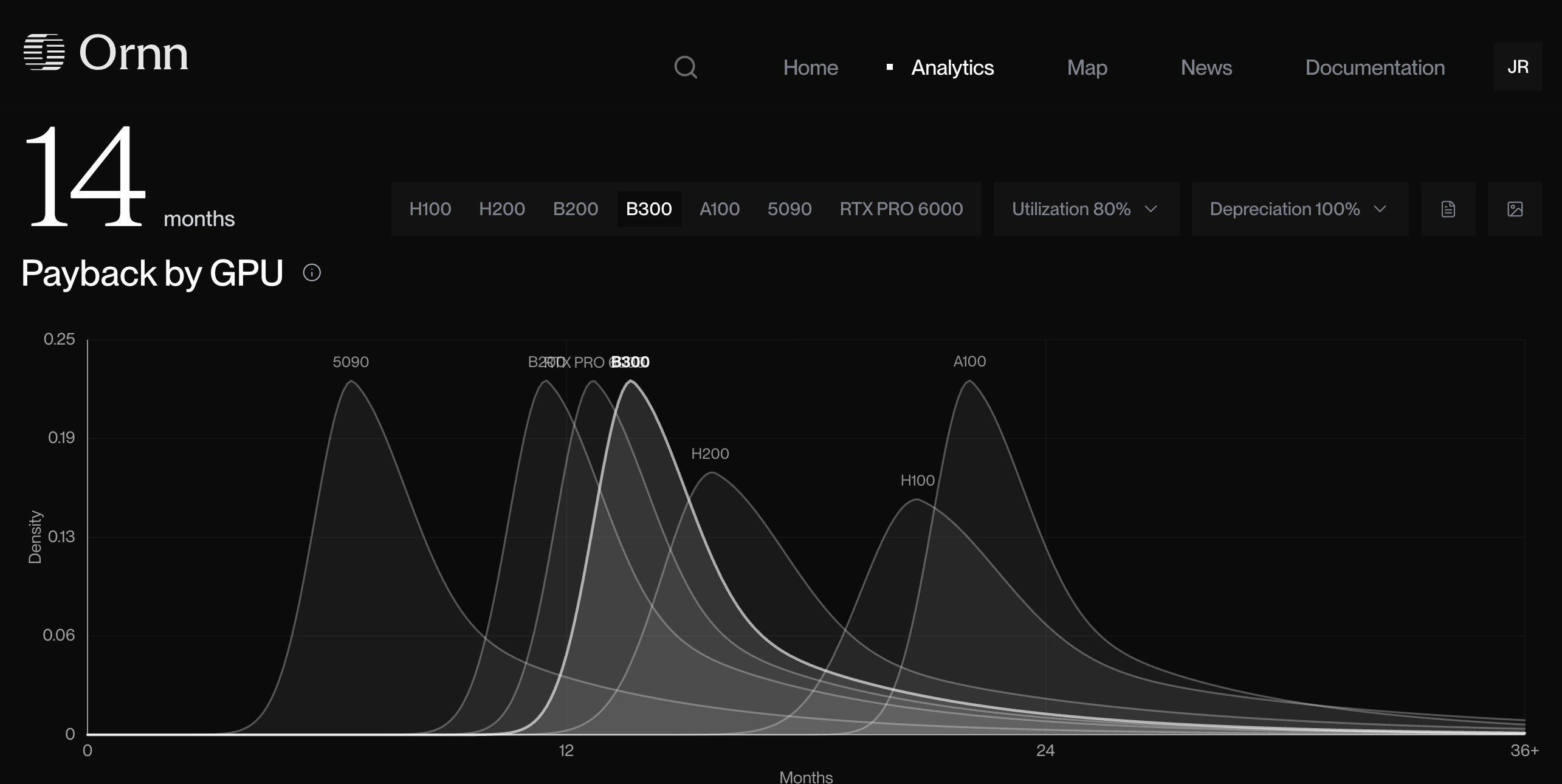
That is not a guaranteed return. It is a modeled payback period whose outcome depends on purchase cost, utilization, rental pricing, operating expenses and the eventual residual value of the hardware.
But if the estimate is even approximately correct, its message is significant:
A newly deployed B300 may possess the payout economics of a high-quality shale well.
The comparison also gives us a better framework for underwriting the emerging neocloud industry.
The B300 as a digital oil well
In oil and gas, an operator commits capital to drill and complete a well. Once production begins, the first question is payout: how long will it take the well’s cumulative cash flow to recover the original investment?
The same logic applies to compute.
A neocloud purchases GPUs, connects them to power and networking, installs them inside a functioning cluster and sells access by the GPU-hour. Once the cluster becomes available to customers, it begins producing revenue.
In Landman terms:
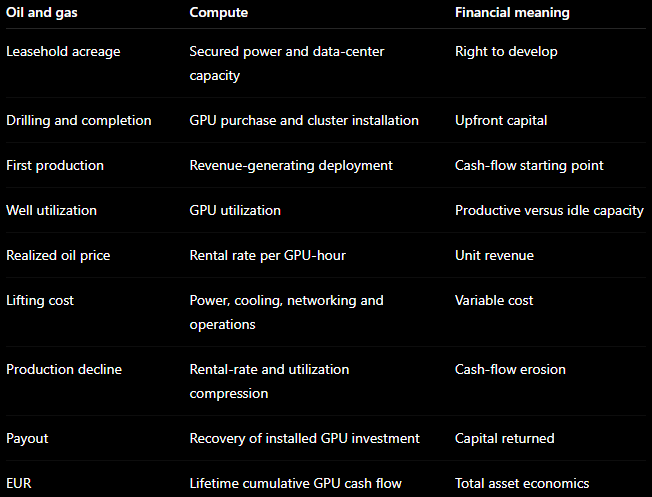
The B300 is powerful hardware. NVIDIA’s DGX B300 configuration includes eight Blackwell Ultra GPUs, 2.1 terabytes of total GPU memory and 14.4 terabytes per second of aggregate NVLink bandwidth. NVIDIA positions the architecture specifically for increasingly compute-intensive reasoning and inference workloads. NVIDIA DGX B300 specifications
But technical performance alone does not establish investment value.
What matters is how efficiently that performance can be converted into cash.
Is 14 months good?
At the hardware level, a 14-month payback is excellent.
The asset theoretically returns its initial capital in approximately 1.17 years. If it then remains economically productive for several additional years, the cash generated after payout can produce an attractive return on invested capital.
In oilfield language, that resembles a good well on Tier‑1 acreage:
Capital is deployed quickly.
Production begins relatively quickly.
Early cash generation is strong.
The initial investment is recovered before the asset reaches its mature decline phase.
Post-payout cash can fund the next development cycle.
This is precisely why payback matters in a rapidly changing technology market. The operator does not need the B300 to remain the world’s leading GPU forever. It needs the chip to return its capital before superior hardware materially erodes its rental economics.
That is the compute equivalent of getting a shale well to payout before its steepest decline overwhelms the initial production.
Yet the comparison requires an important qualification.
A 14-month GPU payback is not necessarily a 14-month neocloud payback.
The well is not the field
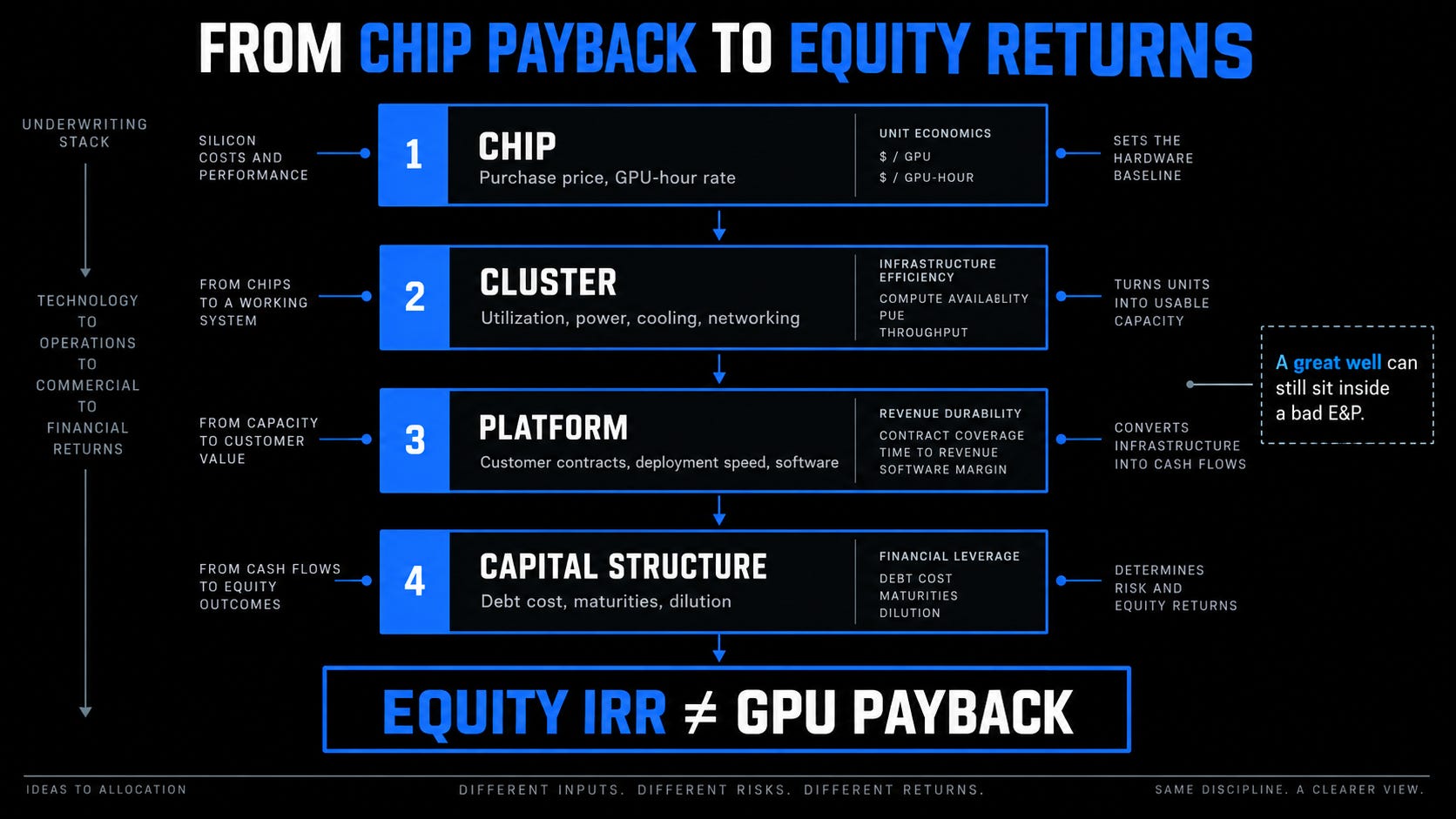
Ornn’s estimate focuses on the chip’s purchase price and expected rental income. A publicly traded neocloud owns a much larger economic system.
Its complete investment may include:
Servers and networking equipment
Electrical infrastructure
Cooling systems
Data-center construction or leases
Software and orchestration
Customer-acquisition expenses
Corporate overhead
Interest expense
Financing fees
Deployment delays
Equity dilution
In the oil patch, analyzing only the well’s drilling cost while ignoring acreage, gathering infrastructure, transportation, overhead and financing would be a form of half-cycle underwriting.
The same mistake can occur in compute.
A B300 might be an exceptional well while the company operating it remains a mediocre investment. Management can still destroy value by paying too much for power, accepting punitive financing, building speculative capacity, missing deployment schedules or allowing hardware to sit idle.
That creates four distinct levels of analysis:
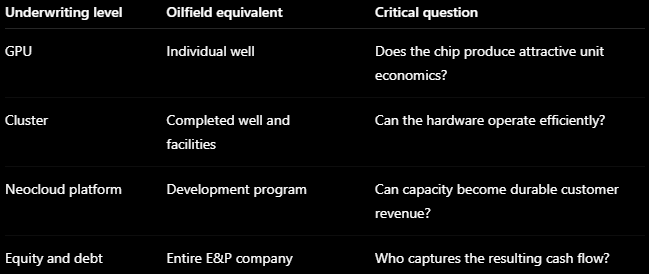
This is the most important distinction for investors:
GPU payback measures asset quality. Equity returns measure asset quality after execution, overhead and capital structure.
A great well can still sit inside a bad E&P.
The neocloud payback equation
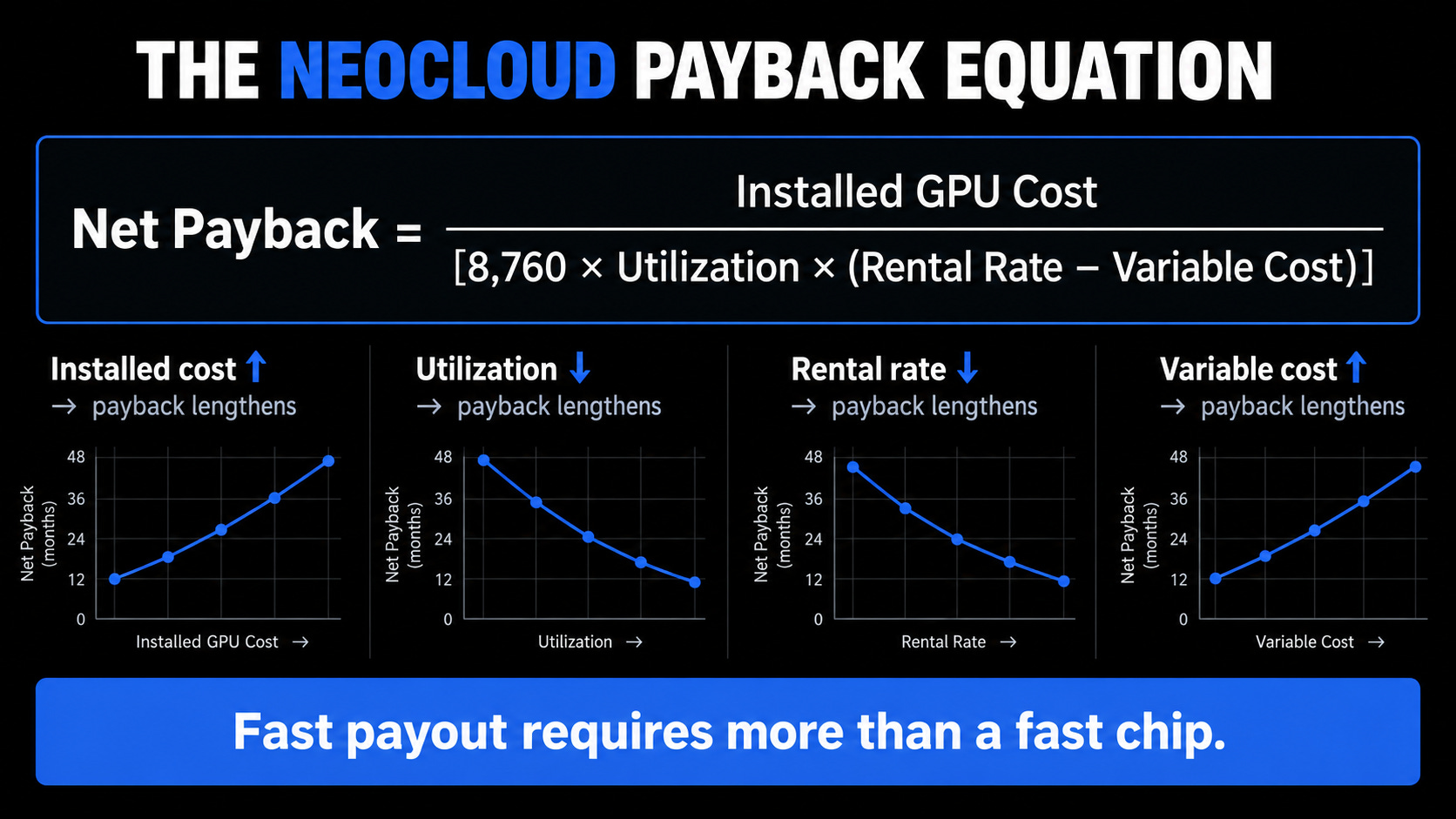
A simple GPU payback calculation begins with:

Where:
U = realized utilization
R = realized rental revenue per GPU-hour
V = variable cost per available GPU-hour
8,760 = hours in one year
The result is expressed in years. Multiplying by 12 converts it into months.
This formulation improves upon a simple purchase-price-versus-rental-revenue calculation because it uses the hourly contribution margin rather than gross rental revenue.
It also reveals exactly what can break the economics.
Installed GPU cost
The numerator should include more than NVIDIA’s invoice price. A more conservative calculation incorporates the GPU’s proportional share of:
Host server equipment
High-speed networking
Installation
Power distribution
Cooling infrastructure
Initial deployment expense
A cheap chip inside an expensive cluster may not actually possess a short full-cycle payback.
Utilization
Utilization is compute’s production volume.
An oil well may underperform because geology disappoints. A GPU underperforms when it sits idle, experiences deployment delays or cannot attract sufficiently valuable workloads.
An 80% utilization assumption means the GPU generates billable revenue for approximately 7,008 hours annually. At 50% utilization, that falls to 4,380 hours.
Because utilization sits in the denominator, modest changes can create large payback extensions.
Holding everything else constant:
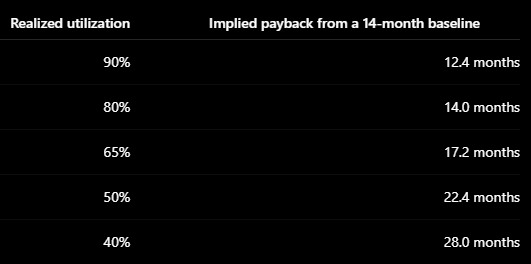
These figures are sensitivity calculations, not Ornn forecasts.
Rental rate
Rental pricing is compute’s realized commodity price.
Ornn’s OCPI methodology uses transacted rental prices rather than advertised cloud listings. Its public market page currently shows separate settled prices for H100, H200, B200 and A100 systems, illustrating how each generation develops its own rental market. Ornn OCPI market data
The B300’s forward curve is therefore crucial. Today’s scarcity price is less important than the average realized price earned throughout the payback window.
Variable cost
Power is compute’s lifting cost—but it is not the only one.
Variable and semi-variable expenses can include:
Electricity
Cooling
Data-center fees
Network transit
Maintenance
Support
Revenue sharing
Workload-orchestration expense
The operator with the lowest all-in cost can continue producing profitably after higher-cost competitors become uneconomic.
That is why secured low-cost power resembles Tier‑1 acreage.
What happens when assumptions deteriorate?
Starting from a 14-month baseline, we can stress the two most important commercial variables: utilization and hourly contribution margin.
The table below applies proportional changes to the original economics. “Contribution-margin compression” means the net amount earned per utilized GPU-hour declines after variable costs.
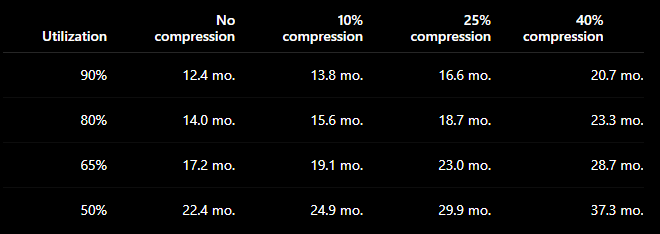
The lesson is not that 14 months is unreliable. The lesson is that the distribution matters more than the headline.
At 80% utilization with durable pricing, the B300 resembles a Tier‑1 well.
At 50% utilization with 40% contribution-margin compression, the same asset takes more than three years to pay out. That creates a far narrower margin before newer hardware arrives.
Compute’s decline curve
Shale wells and GPUs both generate front-loaded economics, but their decline mechanisms differ.
A shale well’s physical production typically falls quickly after initial production. EIA data show why shale operators must continuously add new wells to offset declines from existing production. In 2024, more than 15,000 new Lower-48 wells were required to counteract substantial declines from older wells. U.S. Energy Information Administration
A GPU can continue operating at approximately the same physical capacity. Its economic output declines differently:
New supply pressures rental rates.
A new architecture improves performance per dollar.
Premium workloads migrate toward newer chips.
Older hardware experiences declining utilization.
The asset cascades into lower-value inference or secondary workloads.
Oil’s decline is principally geological.
Compute’s decline is competitive.
That makes the B300 less like a conventional field with decades of predictable production and more like shale: high initial productivity, attractive early payout and a constant requirement to replenish the asset base.
The compute Red Queen
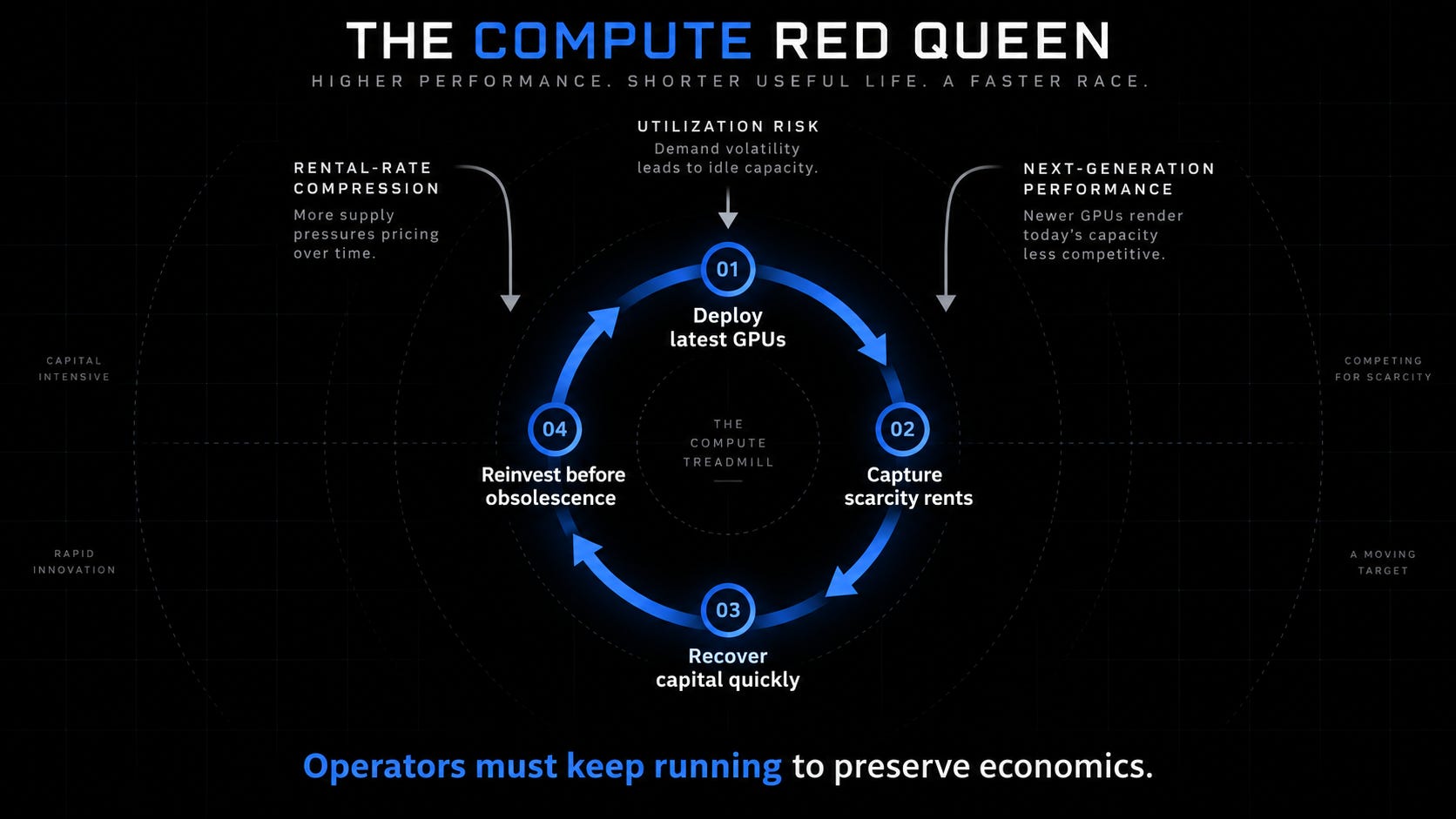
The best neoclouds can create a reinvestment flywheel:
Deploy the newest GPUs.
Capture early scarcity pricing.
Maintain high utilization.
Recover invested capital quickly.
Use the cash flow and collateral value to finance the next generation.
Repeat before existing hardware loses premium status.
This sounds attractive, and it is, but it also creates a Red Queen problem.
The operator must keep running just to maintain its competitive position.
If the company stops reinvesting, its fleet ages. If it reinvests too aggressively, it may produce revenue growth without producing free cash flow. If it uses expensive debt to maintain the cycle, creditors may capture more of the economics than shareholders.
This is why rapid growth alone is insufficient evidence of value creation.
The central question is:
Is reinvestment compounding the equity, or merely preventing the fleet from becoming obsolete?
The neocloud acreage map
The oilfield analogy also helps separate high-quality neocloud operators from promotional ones.
Tier‑1 compute acreage possesses five attributes:
1. Power
The operator controls sufficient, affordable and deliverable electricity.
Announced megawatts are not the same as energized megawatts. Energized megawatts are not automatically revenue-generating megawatts.
2. Deployment speed
The operator can transform power, buildings and GPUs into usable capacity quickly.
A B300 sitting in inventory is the equivalent of a drilled-but-uncompleted well: capital has been committed, but production has not begun.
3. Contract quality
High utilization is far more valuable when supported by durable customer commitments instead of volatile spot-market demand.
Investors should distinguish between:
Contracted and deployed
Contracted but undelivered
Available and uncontracted
Announced but unfunded
4. Cost of capital
Two operators can own identical GPUs and generate radically different equity returns if one finances them at a materially lower cost.
In capital-intensive businesses, funding is part of the operating model.
5. Residual-value strategy
Older GPUs may retain economic usefulness through inference, fine-tuning, research, smaller models and lower-priced cloud tiers.
The best operator does not merely buy the newest hardware. It manages the entire fleet’s workload cascade.
What the 14-month estimate actually tells us
The Ornn forecast does not prove that every B300 deployment will generate an extraordinary return. Nor does it prove that every neocloud deserves a premium valuation.
It tells us something more useful:
Current compute economics may permit new hardware to recover capital before technological obsolescence becomes fatal.
That supports several bullish conclusions:
Advanced compute remains scarce.
Customers are still paying substantial premiums for frontier hardware.
GPU fleets can support asset-backed financing.
Rapid payout can create internally reinforcing capital cycles.
Efficient operators may compound deployment faster than slower competitors.
Low-cost power and contracted utilization are becoming strategic natural resources.
But it also raises a harder question for public-equity investors.
If GPU-level economics are this attractive, capital will chase them. New supply will enter. Rental rates will compress. The advantage will migrate away from simple GPU ownership and toward the operator with the best power, deployment, customer and financing machine.
That is what happened in shale.
The first advantage was access to the resource. The enduring advantage became the ability to develop it more efficiently than everyone else.
Conclusion: compute is the new shale
The B300’s modeled 14-month payback should not be interpreted as a guaranteed clock.
It should be interpreted as an economic signal.
At 80% utilization and along Ornn’s expected rental curve, the newest generation of NVIDIA compute may possess the rapid payout characteristics of a high-quality shale well. That makes it highly financeable, highly productive and potentially capable of generating substantial post-payout cash.
But a chip is not a cluster. A cluster is not a platform. And a platform is not the equity.
The winning neocloud will not simply own the most GPUs. It will control the best acreage, power, deployment capacity, customers and capital, and convert that position into durable cash returns before the technology turns.
Oil companies drill to replace declining production.
Neoclouds deploy to replace declining economic relevance.
Both operate on a treadmill. Both can generate exceptional returns. And in both industries, the winners are not necessarily those who spend the most capital.
They are the ones who recover it fastest, and reinvest it best.
Disclaimer: This is for Educational purposes only. NFA.