After weeks like this one, history favored a bounce over the following week. Over the following quarter, true crash weeks were closer to a coin flip, with very wide outcomes. The most bullish statistic I found, that 11 of the 12 closest historical setups were higher 13 weeks later, comes from a model that lost to a plain base rate at every horizon when I tested it on data it had not seen. For the quarter I anchor on that base rate: 69% of 13-week windows since 1990 ended higher. And anyone buying should expect more pain first. In 5 of 7 past crash episodes, a buyer of the Friday close went at least another 5% underwater before the quarter was out.
The headline stat checks out, with an asterisk
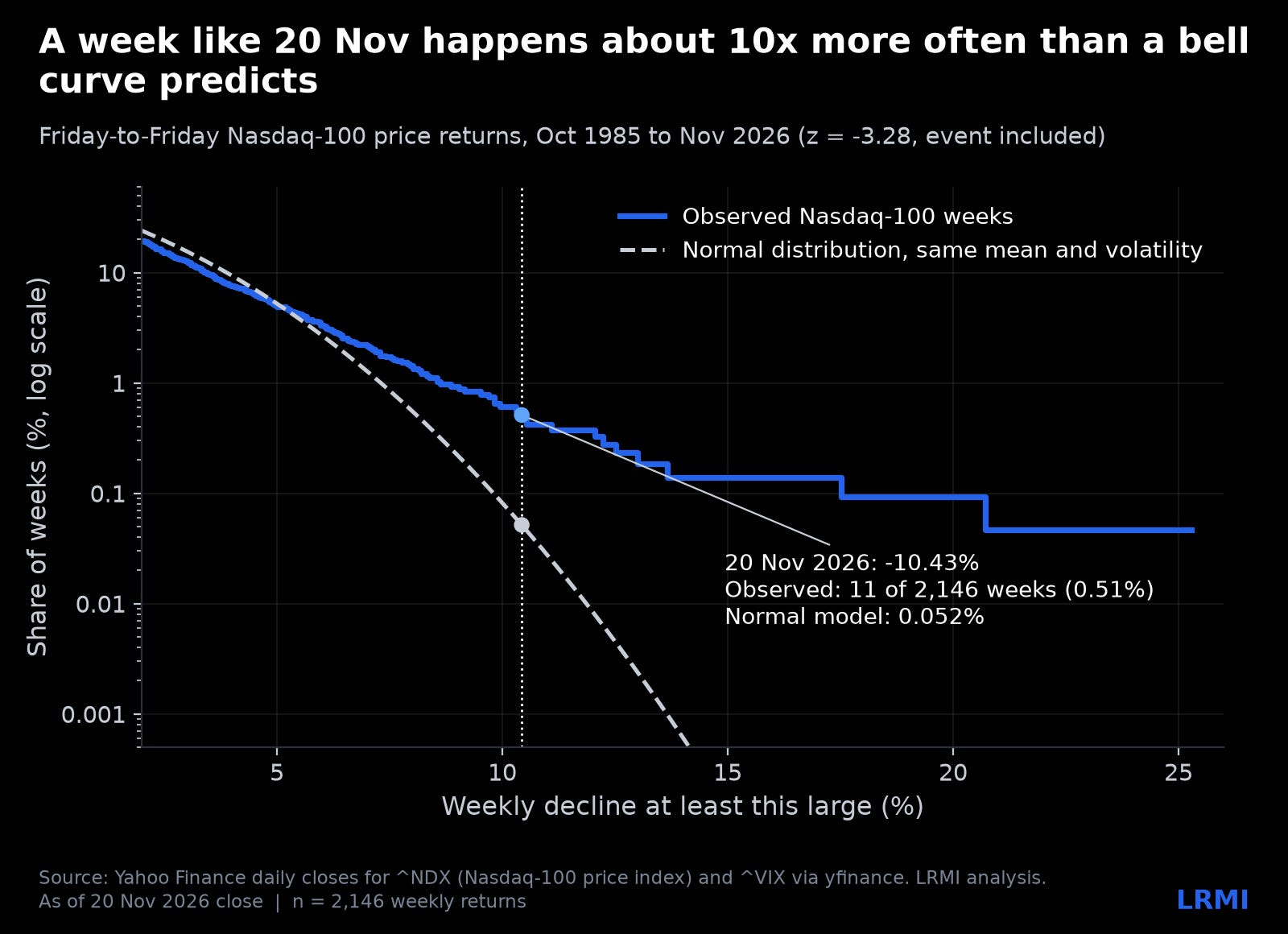
The Nasdaq-100 closed at 25,028.98 on November 20, 2026, down from 27,943.74 a week earlier. That is a weekly decline of 10.43% (exactly −10.4308%). The claim circulating on X, 11 weeks that bad out of 2,133, reproduces exactly on a sample starting in January 1986: a frequency of 0.52% and a z-score of −3.27.
There are two asterisks. First, the count includes this week, so there were 10 earlier precedents. Second, the Yahoo Finance index history starts in October 1985, which gives 11 of 2,146 weeks (0.51%, z = −3.28). Either way, a normal distribution with the same mean and volatility puts a week this bad at 0.052% of the time. Observed frequency is about 10 times higher.
Buying the crash weeks
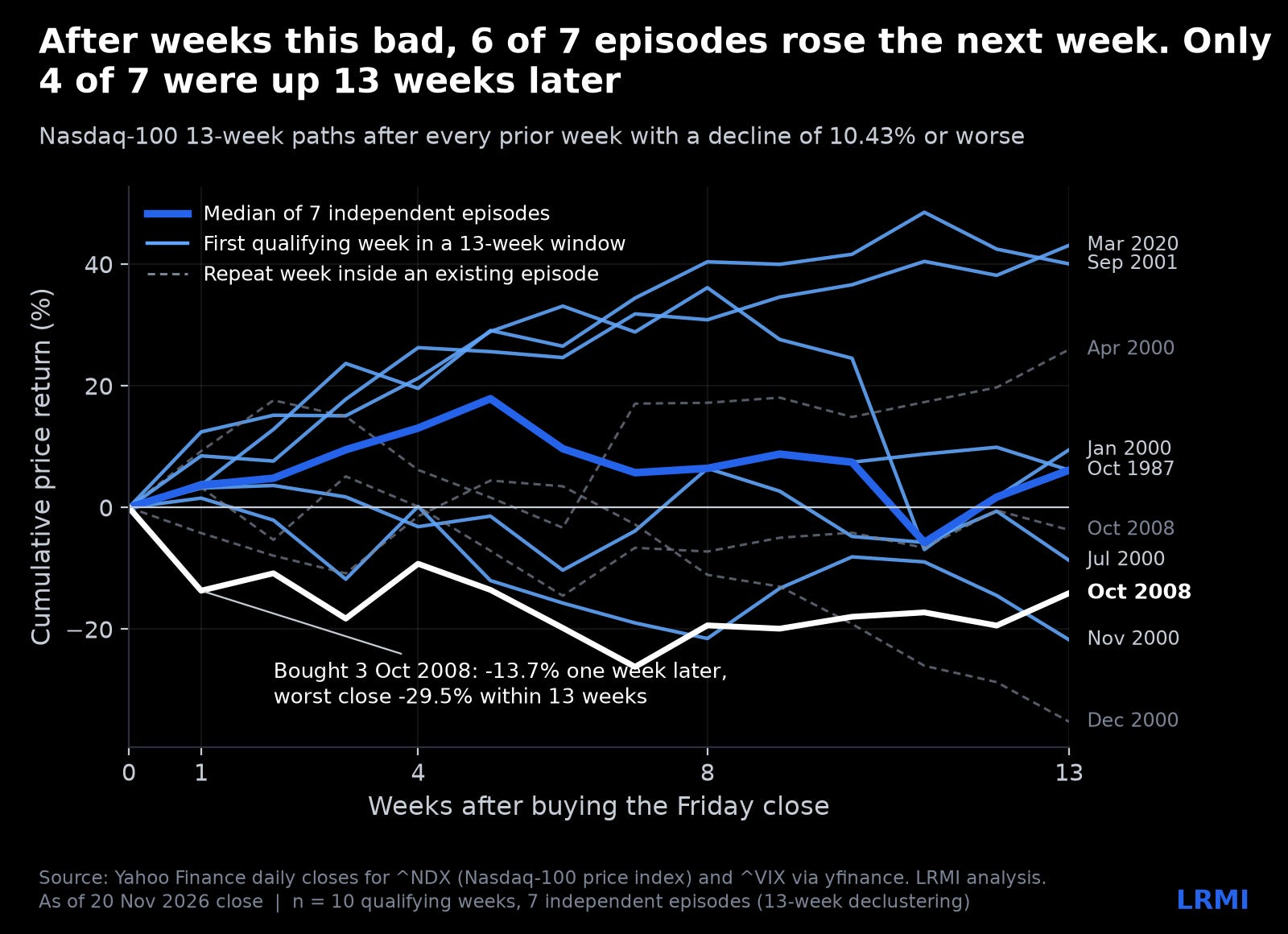
The blunt trade is to buy the Friday close after every earlier week down at least 10.43%. There were 10 such weeks, but they cluster, and counting each as a separate opportunity overstates the evidence. Keeping only the first qualifying week in any 13-week window leaves 7 independent episodes.
Over one week, buying worked: 6 of 7 episodes were higher, with a median gain of +3.7%. Over 13 weeks the picture changes. Only 4 of 7 were higher, the median return was +6.1%, and the 10th percentile was −17.1%. 5 of 7 buyers went another 5% underwater along the way. A random Friday since 1985 did that 45% of the time, and was followed by a 13-week gain 69% of the time, with a median of +4.8%. In this small sample, crash weeks did not improve the odds of being up a quarter later. They widened the range of outcomes.