

One of the most important lessons in investing is that the stock market and the economy are not the same thing.
The S&P 500 can appear resilient, corporate earnings can continue growing, and hundreds of billions of dollars can flow into artificial intelligence infrastructure while the underlying economic environment quietly deteriorates.
This is the subject of Citadel Securities’ latest Global Macro Strategy publication, Latent Fragility, written by Frank Flight.
The piece is particularly interesting to me because its implications extend beyond macroeconomics. It presents a framework for understanding the next stage of the AI investment cycle, the potential for a broader market repricing, and where opportunities may emerge as investors become increasingly selective.
For today’s piece, I want to unpack the research, explain the mechanics behind it, and introduce several of our own frameworks for thinking about what comes next.
I. The Market Beneath the Market
When most investors want to understand the health of financial markets, they look at the S&P 500.
The problem with this approach is that a capitalization-weighted index can conceal weakness elsewhere in the market.
Imagine an economy where a handful of enormous technology companies are performing exceptionally well, while smaller businesses, industrial companies, consumer-facing businesses and corporate borrowers are experiencing deteriorating conditions.
The index may appear healthy even as the economic outlook becomes increasingly fragile.
This is where cross-asset analysis becomes valuable.
Rather than examining an individual asset in isolation, institutional investors can extract information from the relative performance of assets across multiple markets.
For example:
Are cyclical companies outperforming defensive companies?
Are smaller businesses outperforming larger businesses?
Are corporate credit spreads widening?
Is copper outperforming gold?
Are economically sensitive currencies strengthening?
Individually, each signal contains noise. Collectively, they can provide valuable information about changing economic expectations.
Citadel Securities has developed a proprietary indicator called the Cross-Market Internals Growth Factor, or X-MIG, to extract this common signal.
The methodology employs principal component analysis, a statistical technique that identifies shared patterns across multiple variables.
Think of it as extracting a common economic message from several different conversations happening simultaneously across financial markets.
The concern is the magnitude and breadth of the recent deterioration.
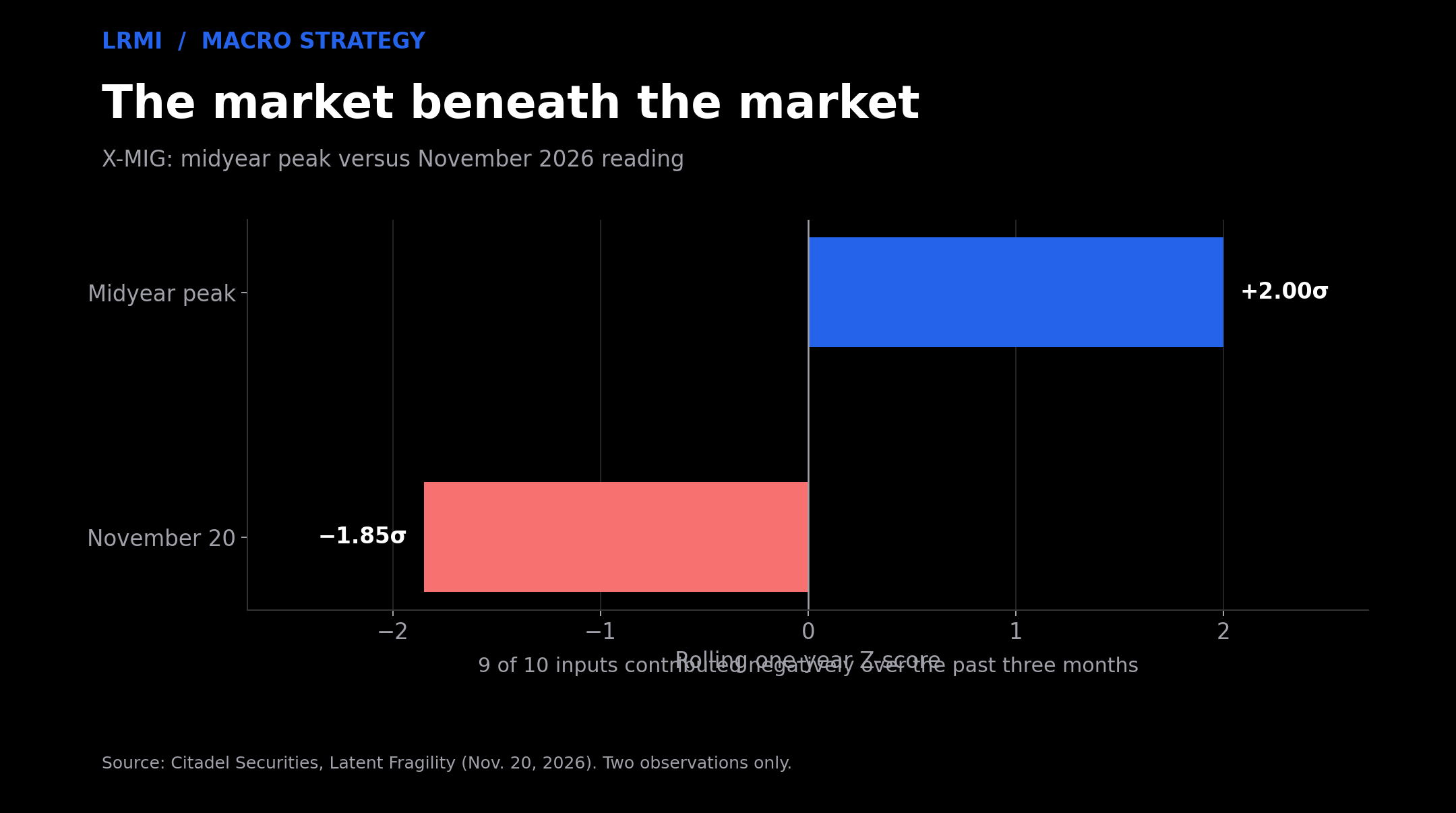
Citadel’s indicator has moved from approximately positive two standard deviations at midyear to negative 1.85 standard deviations.
Nine of its ten underlying inputs contributed negatively over the preceding three months.
This does not mean a recession is inevitable. Market prices reflect changes in risk appetite as well as economic expectations.
However, it suggests investors should question whether the strength of headline indices accurately reflects the health of the underlying market.
II. Understanding the Second Derivative
One of the most important concepts for investors to understand is that markets are forward-looking.
They do not simply react to whether a business is growing. They react to whether that business is growing faster or slower than anticipated.
The same principle applies to the economy.
