

On November 11, NVIDIA’s board accepted Jensen Huang’s resignation as CEO, president, and director, effective immediately. The company announced it the following day. CFO Colette Kress took over as interim CEO while retaining the CFO title, and longtime director Harvey Jones became NVIDIA’s first board chair. The board said it would consider internal and external candidates. Thirty-three years of founder-led NVIDIA ended with an interim appointment and a search. NVIDIA Announces CEO Transition
I’m in the camp that NVIDIA is where it is because of Jensen. The market can point to CUDA, its networking portfolio, and the depth of its developer ecosystem. All of that still matters. But those are also the accumulated results of decisions somebody had to make years before they looked obvious. SemiAnalysis makes that point with CUDA, which took years to pay off while analysts questioned the investment. The next CEO inherits the returns from that bet and the responsibility to make another one. newsletter.semianalysis.com
My answer today would be to hold a core position and trim if it was sized around Jensen staying. The current roadmap and customer relationships still have value. I’d pay a lower multiple for the same near-term earnings if I had less confidence in who will allocate capital, keep the technical team together, and decide which markets NVIDIA spends the next decade building.
The board doesn’t control all the moves
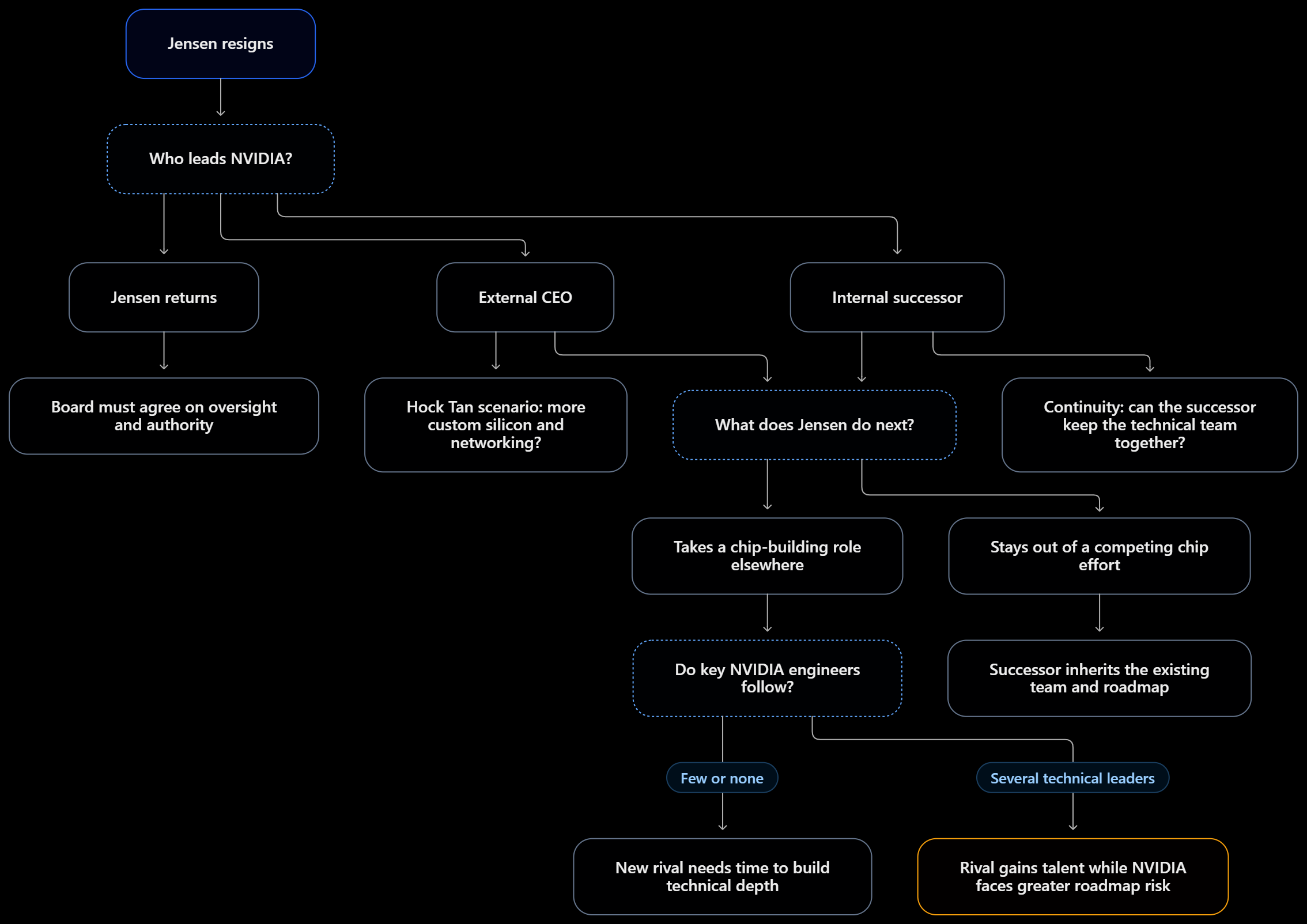
There are three decisions happening at once. The board has to pick a leader. Jensen has to decide what he wants to do next. NVIDIA’s engineers and executives have to decide whether they want to build under whoever takes over. Each decision changes the incentives around the others.
Jensen returns. A credible return could restore confidence in the long-term roadmap and help retain talent. It would also require a governance arrangement the board and shareholders could defend under scrutiny.
An internal successor takes over. An insider offers the clearest path to continuity. The test is whether that person has the authority to settle technical disagreements and commit resources to projects that will take years to pay off.
An outsider takes over. The board gets a chance to reset how NVIDIA is run. The risk is that a new CEO changes investment priorities before understanding which parts of the company’s economics depend on spending ahead of demand.
Jensen builds elsewhere. This can happen alongside either succession path. The impact depends on the mandate he gets, whom he can recruit, and whether the resulting business competes with NVIDIA for customers or for the people who build its products.
I’d love to see Jensen back. I also wouldn’t buy the stock on the expectation that he returns. Semi Doped reported that an ally was organizing a “war room” to lobby the board. That supports the existence of a campaign. Reuters reported on November 16, citing three people, that the board was giving no consideration to a return. Jensen’s reported 3.58% beneficial stake in the March proxy gives him economic influence without voting control. The comeback is upside I’d leave out of my base case. Semi Doped
The SpaceX scenario
Musk publicly said it would be an honor to hire Jensen. A formal offer, a SpaceX appointment, and a mandate to lead Terafab are separate steps. So is the idea that NVIDIA’s best engineers would follow him. gurufocus.com

What makes the scenario interesting is that Jensen wouldn’t need to recreate NVIDIA to hurt it. Imagine SpaceX gives him a budget, a real chip program, and the authority to recruit. A handful of leaders in silicon architecture, interconnect, or systems integration could matter more than a headline about hundreds of engineers leaving. If those hires coincide with uncertainty over who owns NVIDIA’s roadmap, SpaceX could gain a recruiting advantage years before it ships anything competitive. That would make a real Jensen mandate bullish for SpaceX in my eyes. The first evidence would be named hires with specific responsibilities.
What would Hock Tan do with NVIDIA?
Tan is the outsider I’d most want to hear make his case. Under him, Broadcom has built a serious business in custom AI accelerators and networking. He understands the economics of a hyperscaler deciding which workloads to run on general-purpose GPUs and which are valuable enough to justify designing its own silicon. At NVIDIA, that could translate into closer co-design with major customers, a more aggressive networking strategy, or a willingness to offer more tailored silicon where a customer might otherwise go elsewhere. investors.broadcom.com
The trade-off is that NVIDIA benefits from making a common platform valuable to thousands of developers and customers. Too much customer-specific work could pull scarce engineering attention toward the buyers with the most negotiating power. I’d ask Tan one question before drawing a conclusion about the stock. Which NVIDIA investments would you keep funding for five years if they generated almost no revenue over that period? His answer would tell me more about the future of CUDA and NVIDIA’s next big bet than any promise of operating discipline.
The board owes shareholders a better explanation
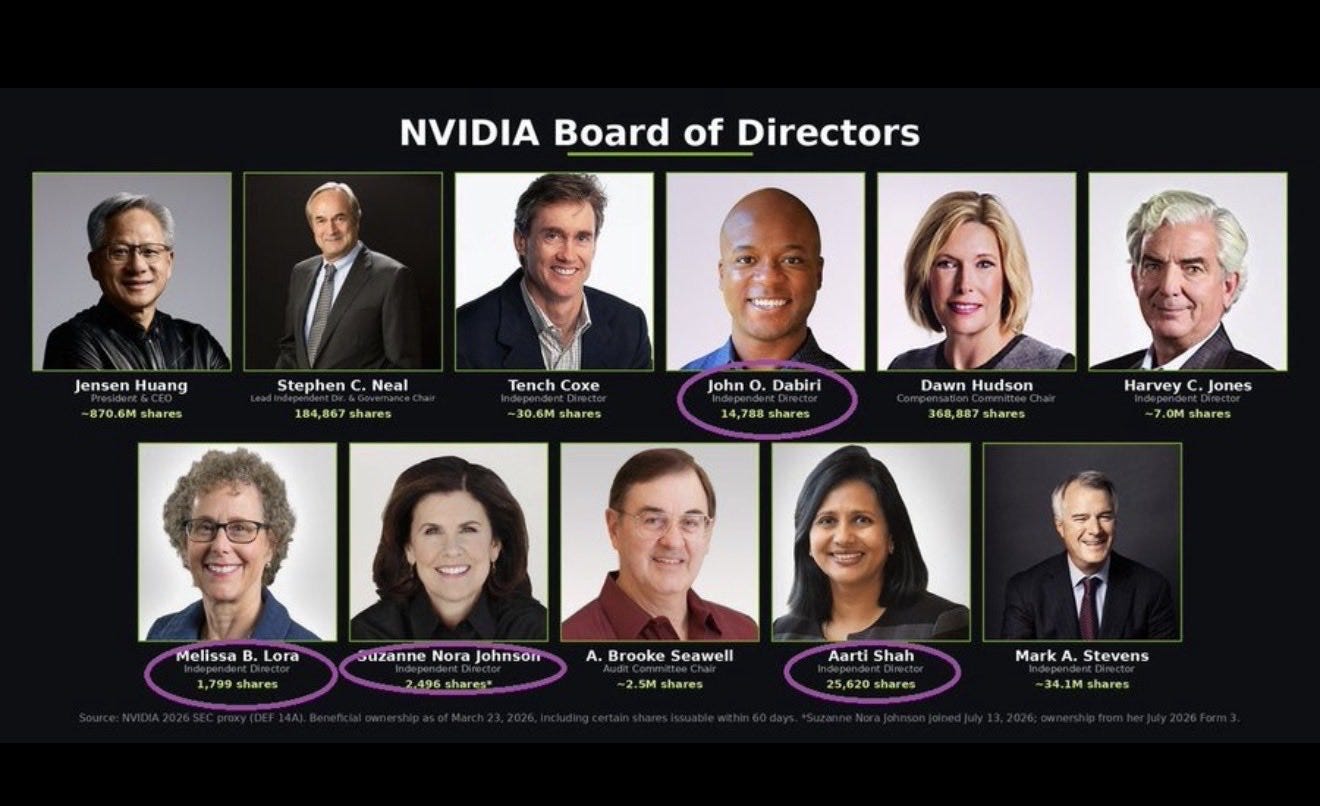
The ownership graphic gets at a fair question about alignment, but the March proxy shows how uneven that ownership is. Melissa Lora had 1,799 beneficially owned shares, including 900 issuable within 60 days. John Dabiri had 14,788 and Aarti Shah had 25,620. On the same disclosure, Mark Stevens had about 34.1 million, Tench Coxe about 30.6 million, and Harvey Jones about 7 million. I’d update the graphic’s caption before publishing it. It’s a historical ownership snapshot, and it still lists Jensen as CEO and director. sec.gov
My criticism is that investors still have too little information to judge how the board prepared for the loss of the most consequential executive in the company’s history. An immediate departure may have been warranted given the circumstances directors faced. Shareholders can still ask what succession planning existed beforehand, why an interim CEO doubling as CFO was the best available arrangement, and who has decision-making authority over technical strategy during the search. The filing establishes when the board acted and whom it appointed. It leaves those questions open. sec.gov
I’d call for an independent review of the succession and oversight process and board refreshment wherever that review finds gaps. If Jensen returns, the board still needs to show it can oversee him and plan for his eventual departure. If he stays out, it needs to show it can recruit, empower, and oversee someone capable of leading NVIDIA through its next architectural transition.
What would make me sell?
NVIDIA’s November 17 earnings call is the first scheduled test. I’ll listen for who owns the Rubin roadmap, whether customer deployment timelines are changing, and what Kress says about keeping technical leaders and their teams in place. Strong guidance would support the near-term earnings case. The answers on technical leadership would do more to change what I’m willing to pay for those earnings. NVIDIA Announces CEO Transition
The sell signal for me would be a cluster of consequential technical departures, slipping product milestones, or customers moving meaningful deployments to alternatives, especially if the stock still trades as though NVIDIA’s execution risk is unchanged. If the team stays together and the roadmap keeps landing on schedule, I can own a smaller position while the succession plays out. What I can’t do is size it on the assumption that Jensen will walk back through the door.