

NVIDIA shipped nearly $20 billion of Vera Rubin in its first production quarter. Blackwell was still growing. I expected a strong Rubin ramp. What caught my attention was that buyers were still taking Blackwell and, according to NVIDIA, some were signing fresh multiyear contracts for Hopper.
That’s the most interesting test yet of what I’ve been calling the Compute Paradox. The price of a token can fall while the price of renting some GPUs rises. If cheaper intelligence drives enough additional usage, the installed fleet can keep earning even as newer chips get dramatically better. For CoreWeave, that renewal on an older fleet could matter as much to lifetime returns as being first to deploy Rubin.
The Compute Paradox

Over the past several months, I’ve spent a lot of time researching the rapidly emerging neocloud space. That has meant going well beyond the surface-level debate around AI infrastructure and trying to understand the entire stack: semiconductor architectures, data center economics, liquid versus air cooling, power generation and grid constraints, and what fundamentally separates neoclouds from the hyperscalers.
Who is actually buying?
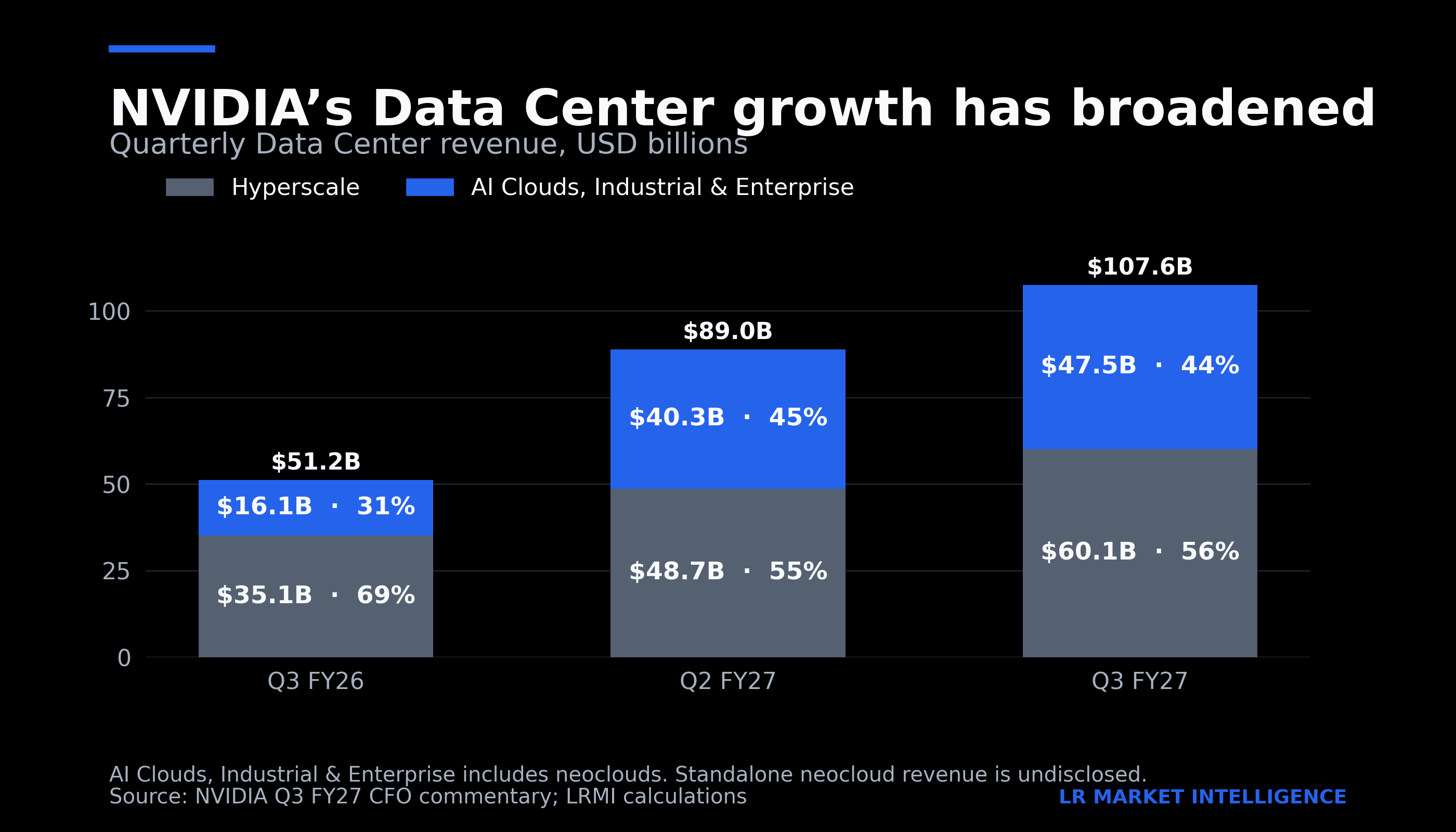
NVIDIA reported $115.8 billion in revenue, up 103% year over year, with $107.6 billion from Data Center. Hyperscale was $60.1 billion, or 56% of Data Center. AI Clouds, Industrial & Enterprise was $47.5 billion, or 44%. The second bucket includes neoclouds, and NVIDIA hasn’t disclosed their standalone share or CoreWeave’s contribution.
The interesting part is which group drove growth. The broader bucket contributed 56% of Data Center’s growth year over year. Hyperscale contributed 61% of growth from last quarter. The business has broadened over the past year while the largest cloud providers are still adding the most dollars at the margin this quarter.
