

On November 24, 2025 President Trump officially launched what is called The Genesis Mission. This is a new landmark national initiative to fuse AI, supercomputing, and decades of government-science data. The Mission will be led by the DOE - The Department of Energy, in collaboration with the White House Office of Science and Technology Policy.
So What?
You might ask: Why does this matter?
The Genesis Mission will drastically accelerate scientific breakthroughs, change the energy landscape, and reshape global competitiveness. This is a major move by the Administration to retain American Hegemony. Dominance through political, economic, and cultural leadership reinforced by consent rather than force.
It is a prime example of Peace Through Strength.
Why Now? New technologies like AI and quantum computing are changing how science works. The Genesis Mission plans to double the output of U.S. research by teaming up scientists with smart computer systems that can think, test, and run experiments faster than ever before.
Welcome to the beginning of a new era. Welcome to The Genesis Mission.
Core Goals & Mechanism
At its center, The Genesis Mission is a modernization effort. The administration wants to take what the U.S. already does well: National labs, Scientific datasets, High-end Computing, and Public-private research partnerships — and make them work together rather than in silos.
Here are the core pillars:
1. Organize and Standardize Federal Scientific Data
For decades, the government has accumulated massive datasets across energy, materials, biology, chemistry, physics, and climate science. Much of it is hard to access or spread across different systems.
Genesis creates a unified structure so this information can actually be used across agencies and research institutions.
2. Upgrade National Laboratories
Many DOE labs already rank among the best scientific facilities in the world — but the workflow is often slow or fragmented.
The Mission aims to streamline:
Experimental design
Testing and validation
Materials screening
Energy research
Advanced manufacturing development
The goal is simple: faster research cycles and more efficient output.
3. Build a Coordinated National Research Platform
Rather than each lab or agency working independently, Genesis creates a shared research backbone. This platform connects:
DOE labs
Federal agencies
Universities
Approved industry partners
The U.S. wants a system where ideas, data, and resources can move across institutions without barriers.
Where Genesis Works First: Priority Focus Areas
The Mission focuses on sectors that matter for national resilience, economic competitiveness, and long-term security:
• Energy
Modernizing nuclear, improving reactor design cycles, strengthening the grid, and advancing next-generation energy systems. NLR 0.00%↑
• Advanced Materials
Developing new materials, improving manufacturing methods, and reducing reliance on foreign critical minerals. REMX 0.00%↑
• High-End Computing & Infrastructure
Better simulation tools, faster design cycles, and modernized research facilities. DIA 0.00%↑
• National Security Technology
Strengthening critical infrastructure and reducing strategic vulnerabilities. ITA 0.00%↑
These are slow-moving sectors with massive upside when discovery becomes more efficient.
Roadmap: What Happens Next
The Executive Order provides a clear set of deadlines:
Within 90 days — Identify computing and cloud resources across government
Within 120 days — Select priority datasets and develop unified standards
Within 240 days — Begin evaluating labs for modernization and automation
Within 270 days — Show demonstrable progress in at least one challenge area
This is not a “someday” initiative. Implementation starts immediately.
Investor Angle: Who Stands to Benefit?
Because Genesis is built on public-private collaboration, investors should follow the companies likely to become early partners. These firms already supply U.S. labs, national infrastructure, or scientific equipment, and direct collaborators mentioned by the DOE. (Source)
1. Semiconductor & Technology Suppliers
These companies provide the computing hardware, chip design tools, and memory/logic components that power scientific workloads and national-lab infrastructure.
NVIDIA NVDA 0.00%↑
AMD AMD 0.00%↑
Micron MU 0.00%↑
Applied Materials AMAT 0.00%↑
Synopsys SNPS 0.00%↑
Why they matter:
Genesis will increase demand for high-end chips, memory, accelerators, fabrication tools, and design software used in research and simulation environments.
2. Large Tech & Cloud Infrastructure
These firms already service federal cloud contracts or supply HPC (high-performance computing) solutions.
Amazon AMZN 0.00%↑ — AWS supports government cloud and HPC workloads
Google/Alphabet GOOG 0.00%↑
Microsoft MSFT 0.00%↑ — Azure Government + research cloud
IBM IBM 0.00%↑ — longstanding DOE supercomputing relationship
Oracle ORCL 0.00%↑ — government cloud + data infrastructure
Dell Technologies DELL 0.00%↑ — servers and HPC systems
Hewlett Packard Enterprise HPE 0.00%↑ — includes Cray supercomputers
Why they matter:
Genesis requires massive computing capacity, storage, secure cloud environments, and tools to manage scientific datasets. These companies already fill that role across federal agencies.
3. Industrial, Aerospace & Energy Infrastructure
These companies support grid modernization, aerospace-grade engineering, nuclear systems, and industrial research tools—all key focus areas under Genesis.
GE Aerospace GE 0.00%↑
RTX RTX 0.00%↑ — includes Collins Aerospace
GE Vernova GEV 0.00%↑ — grid modernization, power systems
Why they matter:
Energy systems, advanced manufacturing, turbine engineering, grid upgrades, and high-reliability components are central to the Mission’s focus on national resilience.
4. Materials, Mining & Critical Minerals
If Genesis accelerates discovery in batteries, critical minerals, and high-performance materials, these companies stand to benefit.
Albemarle ALB 0.00%↑ — lithium
MP Materials MP 0.00%↑ — rare earth elements (My personal favorite for investing in rare-earth minerals)
Why they matter:
The U.S. wants stronger domestic supply chains for energy storage, magnets, electronics, and advanced manufacturing — sectors dependent on critical materials.
5. Communications & Network Infrastructure
These companies support the broader networking, security, and communications systems required for modern scientific facilities.
Cisco CSCO 0.00%↑
Nokia NOK 0.00%↑
Why they matter:
The Mission requires secure, high-bandwidth connectivity across labs, cloud infrastructure, and partner institutions.
Bottom Line for Investors
None of these names are speculative “Genesis stocks.”
They are established companies positioned to supply the essential computing, industrial, materials, and infrastructure backbone that Genesis will rely on.
The smart approach is not to treat Genesis as a short-term catalyst — but as a long-term modernization cycle.
As federal labs upgrade equipment, expand computing capacity, and modernize research facilities, these firms are the most likely beneficiaries.
This is where the early road map points.
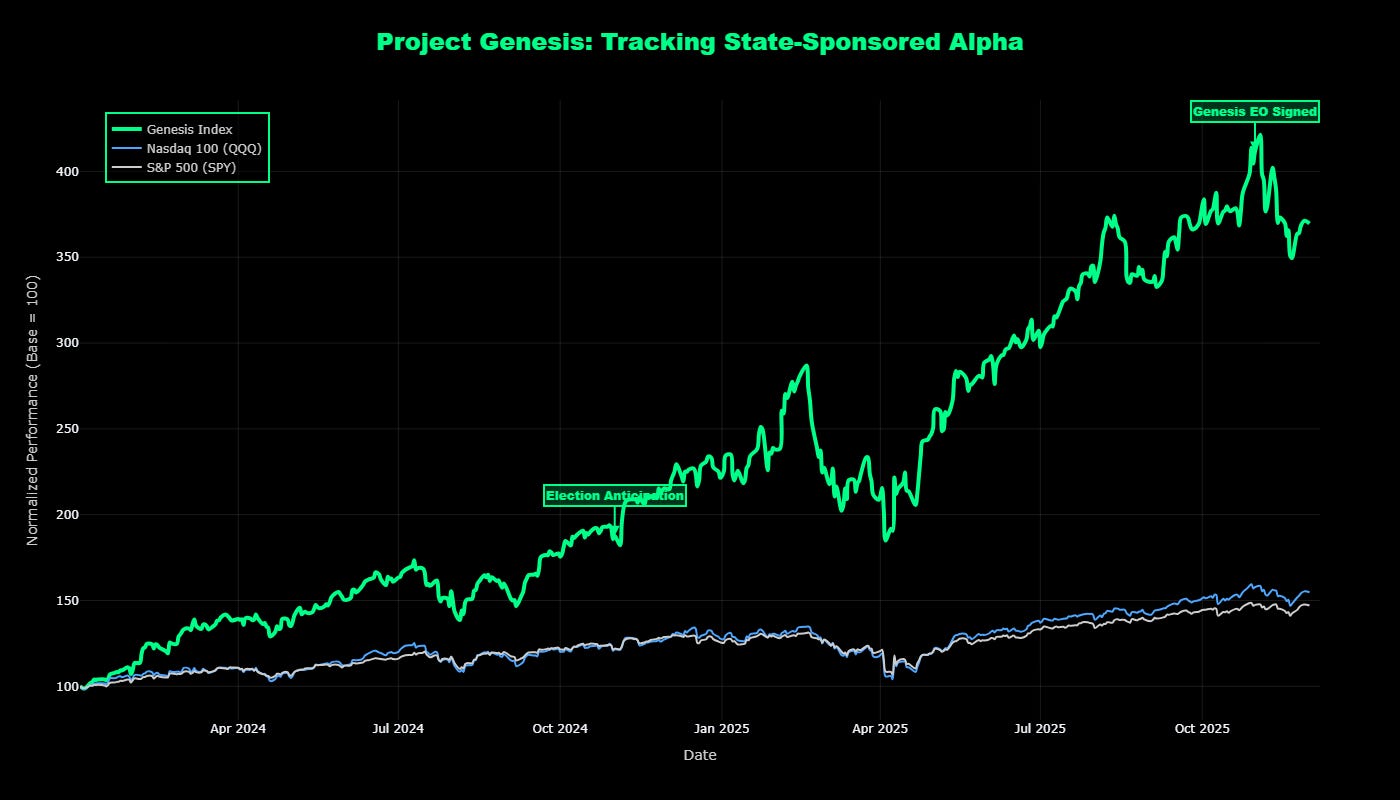
Deconstructing the Alpha: The 5-Layer Stack
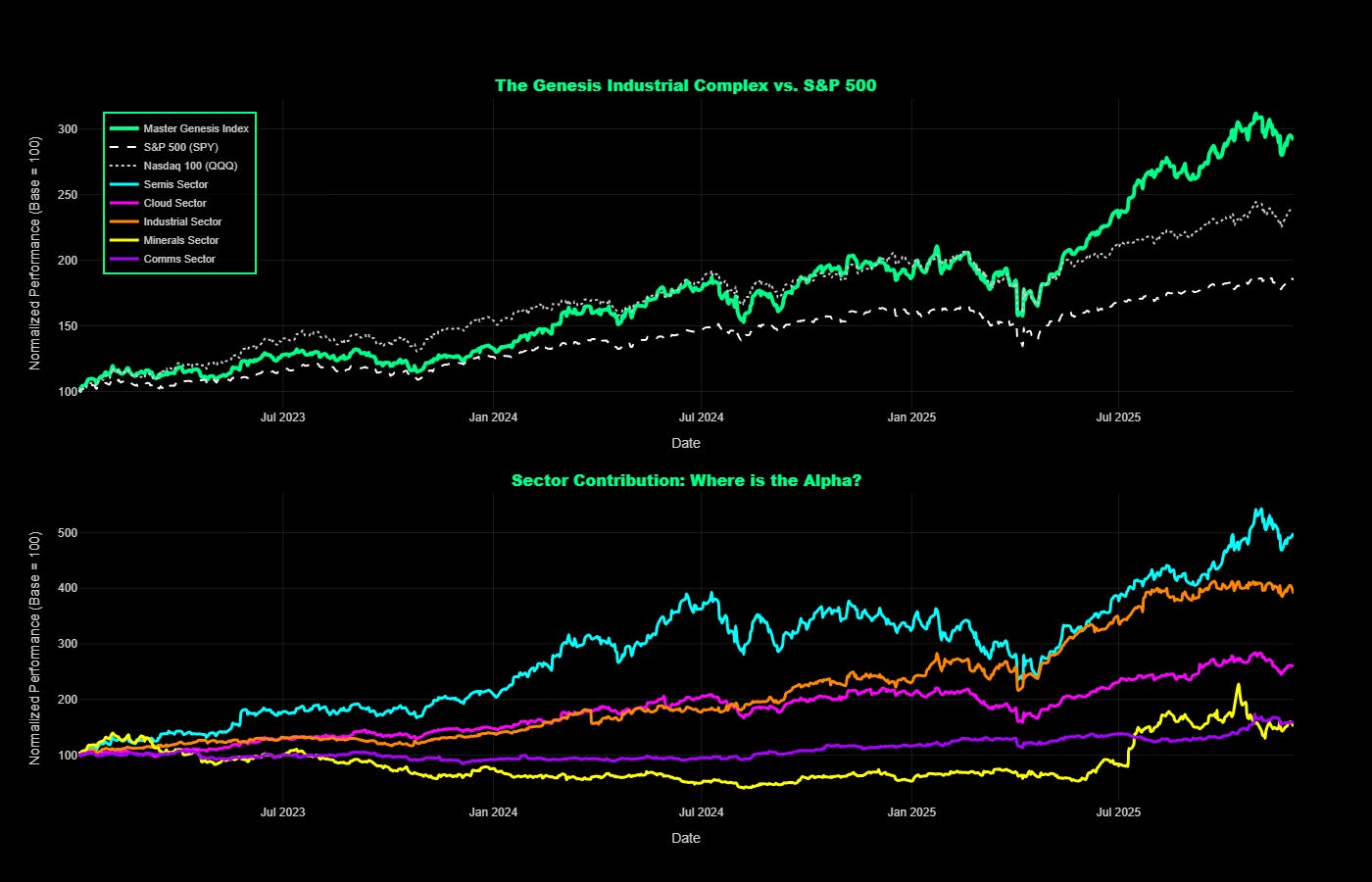
To understand how markets are pricing the Genesis Mission, I built a backtest using python, across what I call the Genesis Industrial Complex — the full supply-chain stack required for a national science and energy mobilization.
It breaks down into five investable layers:
Semiconductors
Cloud / Hyperscaler Infrastructure
Industrial & Energy Systems
Critical Minerals
Communications & Networking
This mirrors the real-world dependencies highlighted in the Executive Order: you cannot expand national research output without chips, compute, power, materials, and networks.
Three Signals From the Breakdown
• 1. The Engine (Cyan)
Semiconductors lead the entire stack — up nearly +500% in the model.
This is the high-beta foundation: America can’t scale labs, reactors, simulations, or scientific analysis without chips. This is the CapEx Phase of Genesis.
• 2. The Breakout (Orange)
The Industrial/Energy sector moved sideways for most of 2023–2024, then ripped higher.
This represents the market realizing a basic truth:
Sovereign Compute is impossible without Sovereign Power.
Grid modernization, turbines, nuclear systems — these become the next bottleneck.
• 3. The Value Play (Yellow)
Critical Minerals are the only sector still below the S&P 500.
If the U.S. intends to secure domestic supply chains for batteries, turbines, magnets, and high-end manufacturing (as stated directly in the EO), this gap is a potential mean-reversion trade.
The Bottom Line
Right now, the market is aggressively pricing the chips (NVDA) and the compute plants (MSFT, AMZN)…
…but it’s only just waking up to the fact that someone still has to power this new research and industrial ecosystem.
That puts GE Aerospace, GEV, Eaton, Siemens, and RTX in prime position for the next leg of the theme.
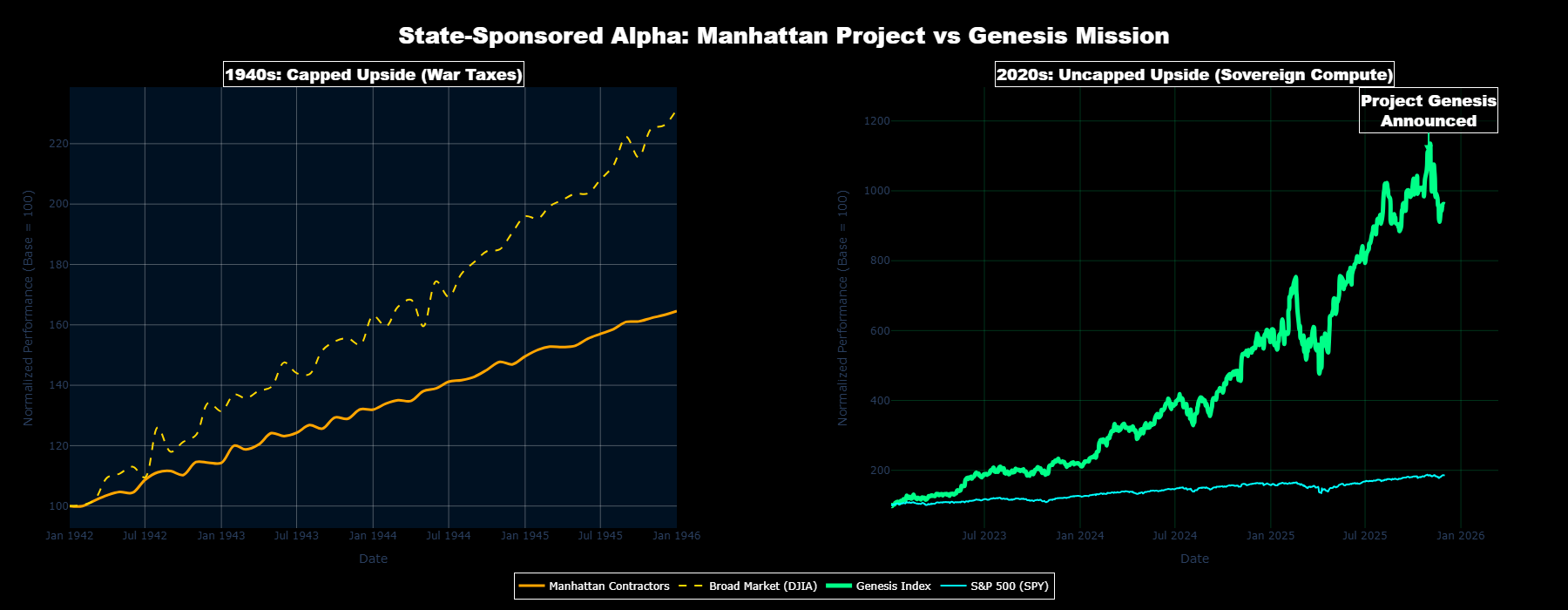
This is where state-backed demand meets real-world constraints — and where the next wave of alpha historically emerges. As shown below, the dynamic rhymes what we saw during the Manhattan Project:
The Bigger Picture
The Genesis Mission is ultimately about coordination and modernization.
If successful, it will:
Shorten research timelines
Create more efficient national labs
Strengthen U.S. competitiveness in energy and materials
Reduce dependence on foreign supply chains
Support long-term industrial and scientific innovation
This isn’t a meme program or a short-term catalyst.
It’s the U.S. rebuilding the backbone of its research ecosystem — quietly but decisively.
Final Word
Genesis is the kind of national project that doesn’t dominate news cycles but will shape the next decade of American scientific and industrial strength.
For investors, the roadmap is clear:
Watch the collaborators, watch the infrastructure providers, and watch the sectors where faster discovery leads to real economic power.
This is the starting point of a long-term structural shift. Welcome to The Genesis Mission.